Stadium guide · Birmingham, England
Villa Park
Aston Villa FC
- Capacity
- 43,205
- Opened
- 1897
Tickets
Membership comes first at Villa Park. An official Aston Villa membership grants priority access to tickets, and the club says Adult and Junior Memberships give the best opportunity to secure a general admission home ticket. The entry point is the Essential Membership, a free online account through which you manage your ticketing account and buy tickets. Its log-in details are the ones the app asks for too.
An official Aston Villa membership grants priority access to tickets.
Aston Villa FC
Official- Who goes first
- Members: an official membership gives priority access to tickets
- Where to buy
- Online, by phone, or at the ticket office at Villa Village
- Your ticket
- Digital only, in the Aston Villa app; add it to Apple or Google Wallet for NFC entry
- No NFC?
- The app shows a barcode instead. Screenshots are not valid
- Cannot go?
- Forward your ticket, like for like, or list it for resale in the app
- Away fans
- Buy through your own club: the Villa ticket office sells home tickets
- From overseas
- Ticket-and-hotel packages through the club’s authorised resellers
- Touting
- Anyone convicted of ticket touting is refused entry
Official routes only. We do not link to resale sites for clubs in England, Wales or Scotland.
Home tickets are sold three ways:
- online, on the club’s ticketing site
- by phone, through the customer service team
- in person, at the ticket office in the Villa Village at the ground
If you’re buying on the day of a match, that happens at the Villa Village ticket office, subject to availability.
Everything the club sells is for home supporters. If you follow the visitors, get your ticket from your own club. A supporter who buys for away fans, or who breaks the ground regulations, loses the right to buy tickets for future matches. From overseas, for a ticket-and-hotel or premium package, the club points you to its list of authorised official resellers.
Every ticket is digital, with no collection, and is issued in the official Aston Villa app only. Don’t look for the code too early: for security, the club does not put QR codes in the app until the day before the game. Then open your ticket in the app before you reach the stadium, as the club recommends. Once opened and saved, it will show with no internet connection, and if the app struggles at the turnstile, the free stadium Wi-Fi gets you to it.
From the app you can add the ticket to Apple Wallet or Google Wallet and tap in with NFC. A phone without NFC still gets you in, because the app also shows a barcode for the turnstile to scan. A screenshot will not work. Small phone chargers are allowed in, as long as they fit in your pocket.
Buying for a group, assign each ticket to the supporter who will use it when you pay, because tickets cannot be reassigned once the match has been played. By default a phone shows only its owner’s ticket; seeing someone else’s needs an App Sharing relationship, and one account can link at most 8 supporters that way.
If you can’t go, forward the ticket or list it for resale in the app. Forwarding is like for like only, senior to senior or concession to concession. Reselling needs a bank account linked to your ticketing account. Each ticket is single-use and cannot be transferred after it has been used to enter the stadium.
Anyone convicted of ticket touting under section 166 of the Criminal Justice and Public Order Act 1994 is refused admission.
Stadium tour and museum
Guided tours of Villa Park are led by a stadium expert, and you book them through the club’s tours page or by phone. The route covers:
- Includes
- Pitchside, dugouts, tunnel, home dressing room
- Led by
- A stadium expert, or a Villa legend on the Legends Tour
- Also
- Press conference area and media centre
- Book
- Online or by phone
- the pitchside, dugouts included
- the home dressing room, the players’ entrance and the tunnel
- the press conference area and the media centre
Have a camera ready for the trophies: you can be photographed with the European Cup, the First Division trophy and the FA Cup, which the club says are on permanent display.
Two variations are on offer. On the Legends Tour a Villa legend takes the place of the stadium expert, and the Tour and Lunch package adds a carvery lunch to the guided tour.
Book on the official site: we link straight to it and earn nothing from it.
Where to sit
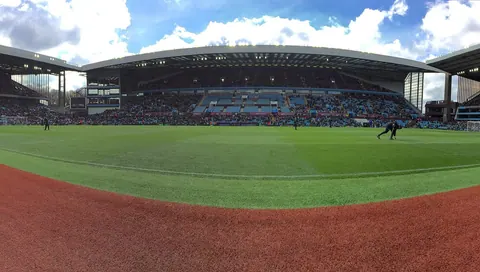
Villa Park keeps four separate stands, each with its own character, in the club’s words:
- Holte EndA double-decker at the south-east end for over 13,000 home supporters.
- Trinity Road StandThree tiers and nearly 13,000 seats along the south-west touchline, with the family area.
- Doug Ellis StandTwo tiers along the north-east touchline, with the away section in its north-east corner.
- North StandAt the north-west end, where the Witton End terrace once stood.
With the visitors, you sit in Block Q of the Doug Ellis Lower or Block P of the Doug Ellis Upper. Block P means a climb: from ground level it is 64 steps in total to the upper concourse. For cup matches the away allocation may take in other areas of Villa Park, to comply with competition regulations.
Families go in the Trinity Road Stand. Children under four are not permitted in the GA, GA+, Club Si or Sports Bar seating areas.
Sit where your ticket says: you may only occupy the seat it allocates, and moving to another part of the ground needs a steward’s permission. Outside licensed standing areas, nobody may stand in a seated area while play is in progress.
| Stand | Where | Tiers | Who sits there |
|---|---|---|---|
| Holte End | South-east end | Two tiers | A double-decker stand for over 13,000 home supporters |
| Trinity Road Stand | South-west side | Three tiers | Home to the family area |
| Doug Ellis Stand | North-east side | Two tiers | Away supporters sit in its north-east corner, in Blocks Q (lower) and P (upper) |
| North Stand | North-west end |

Getting there
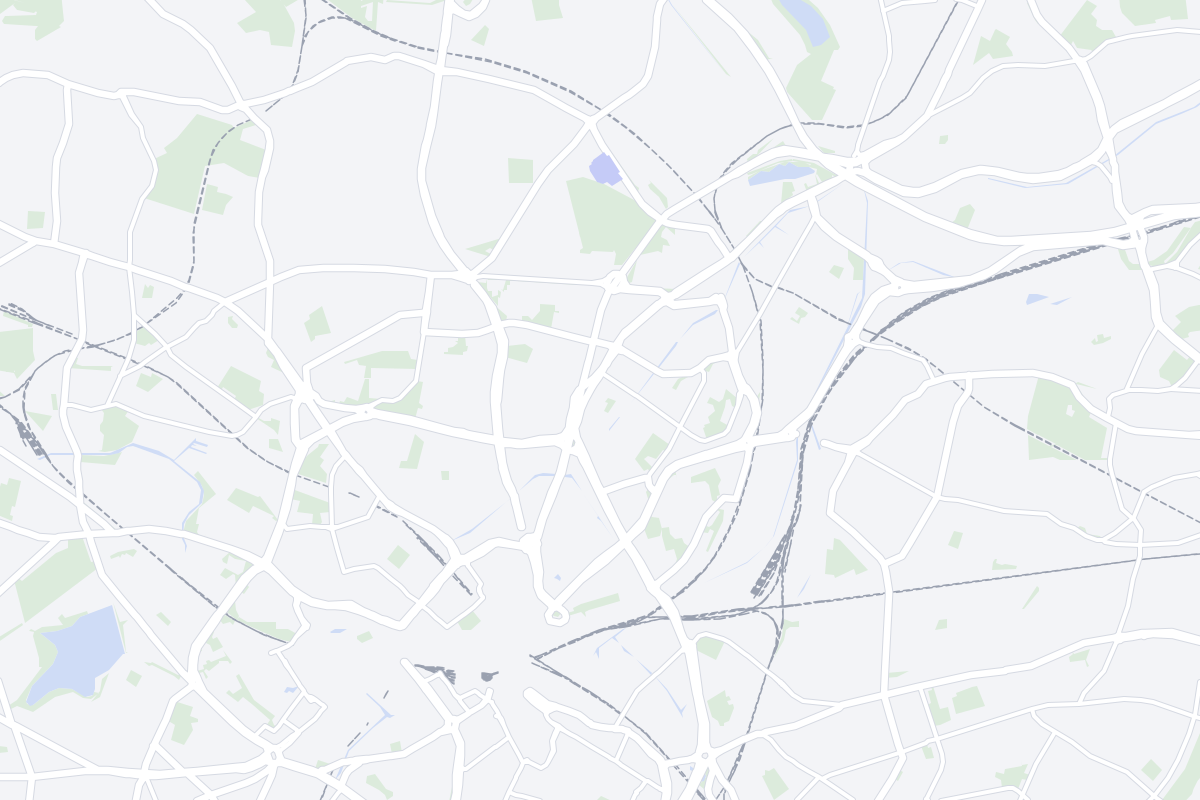
Two railway stations put Villa Park within walking distance, though the ground is about 2.2 miles from Birmingham city centre. Witton is the nearer, about 5 minutes on foot, and it is also the closest station to the away seating. Aston is about 15 minutes’ walk away.
Each station sits on a different route through Birmingham New Street:

- Walsall to Birmingham New StreetWitton5 min on footNearest station, also for away fans
- Lichfield Trent Valley to Longbridge / Redditch via Birmingham New StreetAston15 min on footTwo rail lines, so more frequent trains
- TrainBirmingham New StreetAV82 shuttle leaves from Dudley Street
- 711A11CWitton SquareBus stop for the stadium
- WittonOn the Walsall to Birmingham New Street route, 9 minutes from New Street and 15 from Walsall.
- AstonOn the Lichfield Trent Valley to Longbridge / Redditch route via New Street, 5 to 10 minutes from New Street.
Going back, the shorter walk is not always the better choice. Aston is served by two rail lines, so trains to the city centre run more often than from Witton, and Transport for West Midlands suggests walking there after the match. Every southbound train calls at Birmingham New Street, and after a game they are likely to be busy.
The AV82 shuttle bus, run by Stagecoach on men’s home matches only, picks up outside New Street station on Dudley Street and goes direct to the ground. It starts three hours before kick-off. Afterwards it leaves from Grosvenor Road and runs back to New Street for up to two hours after the final whistle. Home and away supporters can both use it and pay the driver in cash or by card, but nBus concessionary passes are not valid.
Regular buses stop close by too:
- 7The NX 7 leaves the city centre from stop SH6, outside Snow Hill station, and stops at Witton Square, close to the stadium; it is very popular after matches, so expect a wait.
- 11A and 11CAlso for Witton Square; the NX 11A/C outer circle links Erdington, Stockland Green and Gravelly Hill with Witton station.
- 65 and 67Get off at Aston railway station.
Another way back is to walk to the A34 and catch the NX 907 Platinum from the Bragg Road stop, 15 minutes to the city centre. On a bike, the segregated blue route along the A34 links the city centre with Villa Park in about 15 minutes, and there is cycle parking behind the Villa Village, where the store and ticket office are.
Leave the car behind if you can. Parking at Villa Park is for permit holders only, and some road closures begin up to two hours before kick-off. A traffic exclusion zone shuts stretches of Witton Lane and Trinity Road to vehicles from two hours before kick-off until roughly 30 to 60 minutes after the final whistle. Residents’ parking zones cover the surrounding streets on matchdays and are enforced with a parking fine.
If you do drive, pre-book official matchday parking online, and keep the club’s advice in mind: the further away you park, the easier the journey home. From the north-west or south-west, leave the M6 at Junction 7 and follow signs for the A34; from the north-east or south-east via Salford Junction, take Junction 6 for the A38. Away fans are advised to use Junction 6. Disabled parking is arranged through the club’s Disability Access Officer and must be booked 48 hours before the match.
Away coaches park free in the Away Coach Park opposite the ground. Supporters in Tamworth have the Arriva AV1 matchday bus, which leaves 20 to 30 minutes after the final whistle.
From Birmingham Airport, take the train into New Street and change there for Aston or Witton. A taxi takes roughly 20 to 30 minutes.
Expect to queue, however you travel: Villa Park and the streets around it are very busy, most of all once the match finishes.
Where to stay
Base yourself in Birmingham city centre, near New Street, and treat the ground as a short ride out. Trains from New Street reach Aston or Witton in around 10 minutes, and on men’s home matchdays the AV82 shuttle leaves from Dudley Street, just outside the station. It brings you back to New Street for up to two hours after the final whistle. Around Snow Hill, the NX 7 leaves from stop SH6 outside the station for Witton Square, close to the stadium.
- Area 1
Birmingham city centre, around New Street
The stadium is about 2.2 miles away. Trains from New Street reach Aston or Witton in around 10 minutes, and the AV82 shuttle runs direct from Dudley Street.
- Area 2
Aston and Witton
Witton station is a 5-minute walk from the ground and Aston is 15; both have trains to Birmingham New Street.
- Area 3
Erdington
The NX 11A/C outer circle bus links Erdington, Stockland Green and Gravelly Hill to Witton Station.
Staying in Aston or Witton puts the ground on foot: Witton station is about 5 minutes’ walk from it and Aston about 15, and both have trains to New Street.
From Erdington, Stockland Green or Gravelly Hill, the NX 11A/C outer circle bus takes you to Witton station.
Leave big bags where you sleep: anything larger than A4 is turned away at the stadium entrance.
Matchday
Turnstiles usually open 90 minutes before kick-off, which is also when the players usually arrive. To cheer the team in, wait by the Trinity Road entrance. The club suggests taking your seat about 45 minutes before kick-off, when the players come out to warm up. Once you’re through to the concourse, you can’t leave and come back in.
Bring a card, not cash: Villa Park is cashless, and the catering kiosks take debit and credit cards. Bags are searched at the entrance, and any bag larger than A4 is refused. The club advises against bringing a buggy, because of the space available inside.
Bottles, glass vessels, cans, poles and drones are among the items barred from the ground. Smoking and e-cigarettes are not allowed inside, as at every Premier League stadium. Trying to enter the ground drunk, or being inside it drunk, is an offence under the Sporting Events (Control of Alcohol etc.) Act 1985.
In the away section, alcohol is sold only in the Doug Ellis Lower, Block Q, and not in Block P upstairs.
The stadium
Before any football, the site was the Aston Lower Grounds, an amusement park and gardens. Villa moved in from Perry Barr in April 1897, a week after becoming the second club to win the League and Cup double. Their first match at the new ground was a 3-0 win over Blackburn Rovers, watched by around 14,000.
The record crowd is 76,588, for an FA Cup quarter-final against Derby County in March 1946. The club says no venue has staged more FA Cup semi-finals. Villa Park hosted matches at the 1966 World Cup and the 1996 European Championship, and the last Cup Winners’ Cup final, in 1999, when Lazio beat Real Mallorca.
The Holte End was once the largest behind-the-goal terrace in Europe. It was demolished after the last game of the 1993/94 season, and its double-decker all-seater replacement was in use seven months later. The 1923 Trinity Road stand was bulldozed in the summer of 2000, and the three-tier stand that replaced it was officially opened by Prince Charles in 2001. The two-tier Doug Ellis Stand, named after a club chairman, took the place of the small Witton Lane stand, and the open Witton End terrace gave way to what became the North Stand. Floodlights arrived in 1958, on pylons in all four corners.
The club’s tour page gives the capacity as 43,205.
Facts
| Official name | Villa Park |
|---|---|
| Also called | Aston Villa stadium, Villa Park Birmingham |
| Club | Aston Villa FC |
| City | Birmingham, England |
| Opened | 1897 |
| Capacity | 43,205 |
| Stations | Witton (5 min on foot), Aston (15 min on foot), Birmingham New Street, Witton Square |
| Coordinates | 52.50917, -1.88472 |
In our lists
- Premier League stadiums 2026–27 — 9th of 20 by capacity
- The biggest football stadiums — 44th of 112 by capacity
- The oldest football grounds — 16th of 112 by age
- Stadium tours and museums
- Clubs where members buy first
Map
- Villa Park
- Witton
- Aston
- Birmingham New Street
Nearby stadiums
St Andrew's
Birmingham · 3.9 km away
The Hawthorns
West Bromwich · 5.4 km away
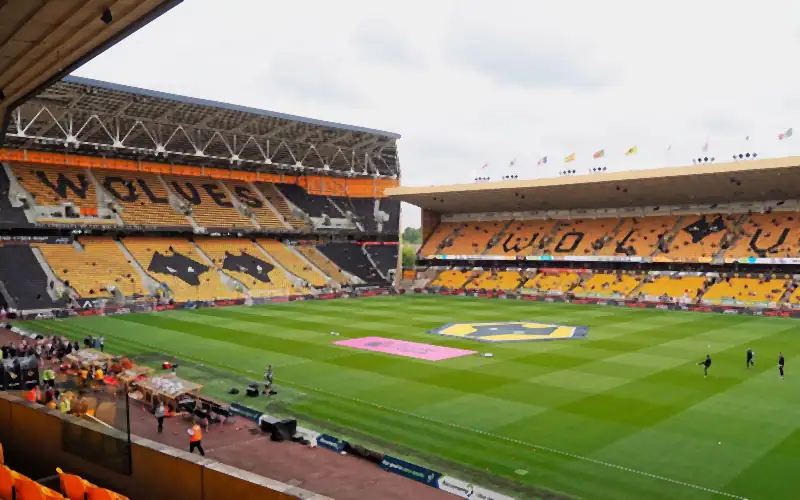
Molineux Stadium
Wolverhampton · 19 km away


Sources
Every fact on this page comes from one of 22 sources, each read and checked in November 2026.
- Aston Villa FC: About Villa Parkavfc.co.uk · in English · retrieved 16 November 2026
- Aston Villa FC: In-app Ticketingavfc.co.uk · in English · retrieved 16 November 2026
- Premier League: Villa Park - Getting Therepremierleague.com · in English · retrieved 16 November 2026
- Aston Villa FC: Travel & Parkingavfc.co.uk · in English · retrieved 16 November 2026
- Aston Villa FC: First Time at Villa Parkavfc.co.uk · in English · retrieved 16 November 2026
- Transport for West Midlands: How to get to Villa Parktfwm.org.uk · in English · retrieved 16 November 2026
Show all 22 sources
- Aston Villa FC: Stadium Toursavfc.co.uk · in English · retrieved 16 November 2026
- Aston Villa FC: Away Supporter Information (visiting supporters guide, PDF)images.gc.avfcservices.co.uk · in English · retrieved 16 November 2026
- Aston Villa FC: Ground Regulationsavfc.co.uk · in English · retrieved 16 November 2026
- Aston Villa FC: Everton ticket detailsavfc.co.uk · in English · retrieved 16 November 2026
- Wikidata: Villa Park (Q175339)wikidata.org · in English · retrieved 16 November 2026
- Aston Villa FC: Essential Membershipavfc.co.uk · in English · retrieved 16 November 2026
- Aston Villa FC: On-sale dates for home Premier League matchesavfc.co.uk · in English · retrieved 16 November 2026
- Avanti West Coast: Trains to Villa Park Stadiumavantiwestcoast.co.uk · in English · retrieved 16 November 2026
- Wikidata: Witton railway station (Q2791793)wikidata.org · in English · retrieved 16 November 2026
- Wikidata: Aston railway station (Q1978485)wikidata.org · in English · retrieved 16 November 2026
- Wikidata: Birmingham New Street railway station (Q683063)wikidata.org · in English · retrieved 16 November 2026
- Aston Villa FC: Official Club Resellersavfc.co.uk · in English · retrieved 16 November 2026
- OpenStreetMap: Way 124420169: North Standopenstreetmap.org · in English · retrieved 16 November 2026
- OpenStreetMap: Way 124420172: Trinity Road Standopenstreetmap.org · in English · retrieved 16 November 2026
- OpenStreetMap: Way 124420174: Holte Endopenstreetmap.org · in English · retrieved 16 November 2026
- OpenStreetMap: Way 124420177: Doug Ellis Standopenstreetmap.org · in English · retrieved 16 November 2026