Stadium guide · Dortmund, Germany
Signal Iduna Park
SIGNAL IDUNA PARK · Borussia Dortmund
- Capacity
- 81,365
- Opened
- 1974
Tickets
Buy from the club or not at all. Home tickets are sold only through the BVB online ticket shop or the club’s Adrenalin Trips packages, and the club says it offers none through third-party sellers.
The club sells home tickets only through its own online shop and says it offers none through third parties.
Borussia Dortmund
Official- Where
- The club’s online ticket shop, and nowhere else
- Members
- Members get shop access first, usually 1 to 2 days before general sale
- General sale
- Usually opens 4 to 6 weeks before the match; the club decides game by game whether non-members can buy
- Sold out?
- The official Zweitmarkt inside the shop, open until 2.5 hours before kick-off
- Third parties
- Tickets from unauthorised sellers give no right of entry
- Your ticket
- Printed, digital or NFC (Apple and Google Wallet); QR code if the phone has no NFC
- At the gate
- Carry an official identity document, such as an ID card or passport
- Away fans
- Tickets for visiting fans come through the visiting club
Official routes only. The club says tickets resold on marketplaces are generally not valid, so we do not link to them.
Membership shapes almost everything after that. General sale for a Bundesliga, Champions League or DFB-Pokal home game usually opens four to six weeks before the match, and members usually reach the shop one to two days earlier. The club’s membership page goes further, promising members preferred access for every home and away game, mostly several days ahead of general sale. Whether non-members get tickets for a game at all is decided individually, match by match. A season ticket is no way in either: the club closed its waiting list because of the sheer number of requests. If you’d rather not book separately, the Adrenalin Trips pair a match ticket with a hotel.
When a match sells out, turn to the Zweitmarkt, the club’s official ticket exchange. It opens once every day ticket has gone, and its tickets sit in the regular BVB ticket shop alongside the others. It stays open until 2.5 hours before kick-off. Only tickets bought directly from the club can be listed there. One catch for visitors: if a game was sold to members only, its Zweitmarkt tickets can only be bought by members as well.
Stay away from every other seller. The club’s ticket terms say tickets offered on unauthorised platforms or by other third parties give no right of entry, and they forbid commercial resale outright. The terms also let the club block and cancel the tickets concerned without compensation, and refuse their holder entry or remove them from the ground. The club says it sees fans turned away with fake tickets from other sellers at every matchday.
You can bring your ticket printed, as a digital ticket or as an NFC ticket. The NFC ticket goes into Apple Wallet or Google Wallet; a phone without NFC gets a mobile ticket with a QR code instead. Buying for friends, you can forward digital day tickets to other people from your shop account, from when the game is scheduled until 2.5 hours before kick-off. Carry an official identity document, such as an ID card or passport, because the club or security staff can ask to see it.
Away supporters get their tickets through the visiting club, which also passes on further fan information.
Children aged six and under can come in on a Kinderzählkarte, a lap pass bought at the clearing points against proof of age; the child sits on the adult’s lap with no seat of their own. From seven, a child needs a full ticket. Members of the BVB KidsClub have a pre-purchase right for the family block. Day tickets for wheelchair places are few, and are given out only through an online draw.
Stadium tour and museum
Pick a guide or a marked route: the club runs guided stadium tours and a self-guided walk, both behind the scenes. The guided tours take in the players’ dressing room, the Südtribüne, the tunnel and coaches’ bench, the stadium jail, the media centre, hospitality areas and the west stand. The Stadionspaziergang is no guided tour: you follow a marked route on your own, past the Südtribüne, the dressing room, the mixed zone and the coaches’ bench at the pitchside.
Both start at the FanWelt, on the north side of the stadium. Tickets for the public offers are sold at the tours counter there, but the club calls its public guided tours very popular, with a limited quota, and recommends booking them ahead.
Keep the visit well clear of a home game. No stadium visits take place on home matchdays, and that includes home matchdays of the BVB U23 team. Under UEFA rules there are none on the day before a home game or on the matchday itself.
Neither the guided tours nor the stadium walk is step-free; the club offers a separate step-free version of the guided tour.
The BORUSSEUM, the club museum, tells the whole BVB story, from its beginnings at Borsigplatz to the team’s biggest successes. You’ll find its entrance behind the August-Lenz-Haus at the north-east corner of the stadium, with step-free access. A combined ticket links the museum with the stadium walk.

- Starts
- At the FanWelt, north side of the stadium
- Walk
- Self-guided on a marked route, no guide
- Museum
- BORUSSEUM, with a combined ticket
- Match days
- No visits on home matchdays
Book on the official site: we link straight to it and earn nothing from it.
Where to sit
Expect competition for the Südtribüne: the club says a ticket for the Süd is highly sought after among BVB fans. This is the Gelbe Wand, the yellow wall, which the club says is known everywhere, at home and abroad. The club calls it the biggest standing terrace in Europe, and it holds blocks 10 to 15 and 80 to 84. On its own page the club credits the black-and-yellow sea of flags and the fans’ songs with making every visit unique. For international matches its standing places can be converted into seats.
The other three stands, as the club’s stadium plan lists them:
- WesttribüneBlocks 20 to 27 and 30 to 34.
- OsttribüneBlocks 40 to 54, with a wheelchair area in block 6.
- NordtribüneBlocks 60 to 78.
Visiting fans come in at the north. Standing tickets in blocks 8, 60 and 61, and seats in blocks 70 or 75, use the Nord-Mitte entrance; seats in blocks 55 to 59 use Nordost.
Families have their own block, 64 and 65 in the north-west corner, with more than 1,500 seats. Smoking, e-cigarettes included, is banned there. A child on a lap pass may not go into the standing areas.
Don’t wear the visiting team’s colours in the BVB standing blocks or in the south-east and south-west corners: the club forbids it.
| Stand | Who sits there |
|---|---|
| Südtribüne | Blocks 10 to 15 and 80 to 84: the standing terrace known as the Gelbe Wand (yellow wall) |
| NordtribüneAway | Blocks 60 to 78, including visiting fans’ blocks 60, 61, 70 and 75, and the family block (64 and 65) in the north-west corner |
| Westtribüne | Blocks 20 to 27 and 30 to 34 |
| Osttribüne | Blocks 40 to 54, with a wheelchair area in block 6 |

Getting there
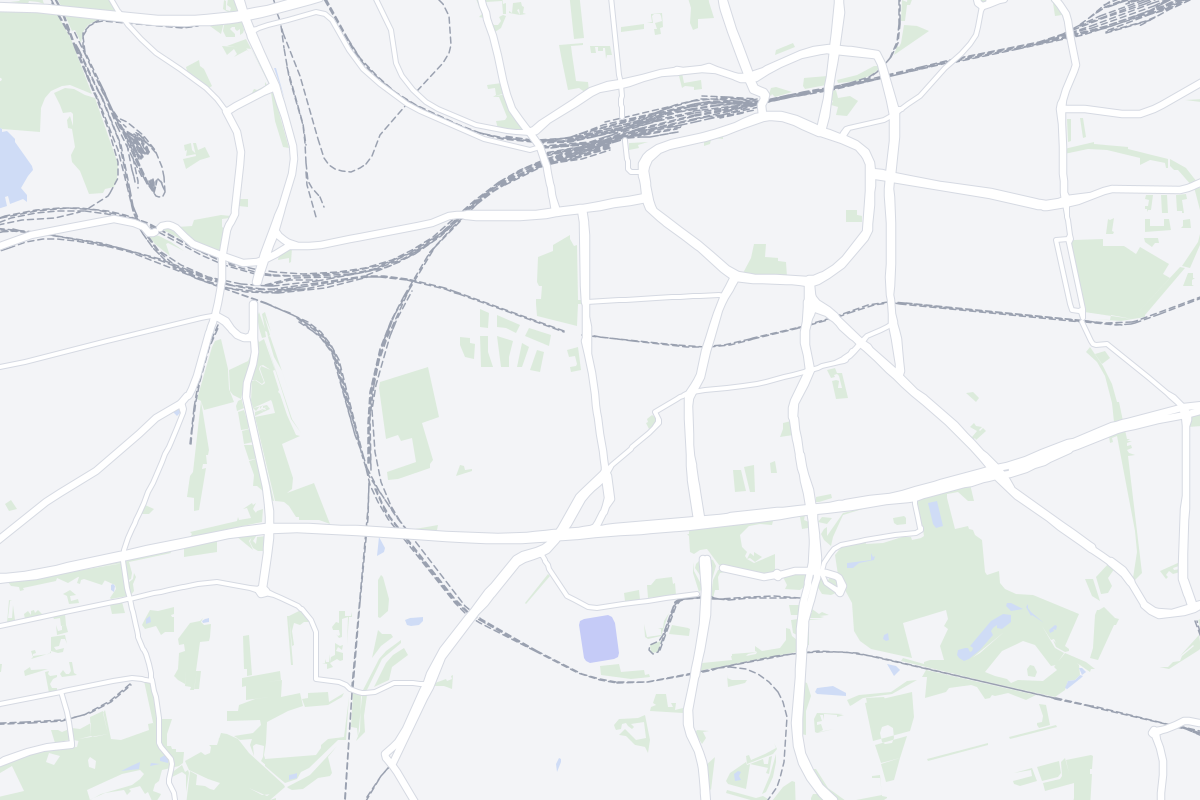
The U45 is the line to know. DSW21, the local operator, and the club both call it the most important light-rail line towards the stadium; it runs from Fredenbaum through the Hauptbahnhof to Westfalenhallen. From about three hours before kick-off until up to 90 minutes after the final whistle, trains run at least every five minutes between Hauptbahnhof and the Stadion stop. At the main station, football fans are sent to the light-rail platform through the north entrance.
The two stops nearest the ground are on other lines: Theodor-Fliedner-Heim on the U42 and Westfalenhallen on the U46. Both lines call at Reinoldikirche in the city centre.
Regional trains also run from the Hauptbahnhof to Dortmund Signal-Iduna-Park station. Be patient there after the match: the club says platform and train capacity is limited, and asks you to allow enough time. You can also walk, since DSW21 puts the main station about 3 km from the stadium, 30 to 40 minutes on foot.
Your match ticket is also a travel ticket, though the club and DSW21 word the rule differently. The club says a season or day ticket covers local public transport across North Rhine-Westphalia on matchday and into the early hours of the next day. DSW21 describes BVB tickets as valid for one return journey on the day of the match. With a digital or print-at-home ticket you need a separate free travel ticket, which you request with your match ticket.
Bus 450 between Kirchhörde and Westfalenhallen gets extra vehicles on match days. A university shuttle runs between the university and Theodor-Fliedner-Heim, from 2.5 hours before kick-off until about two hours after the final whistle.
If you fly, Dortmund Airport is 12 km from the stadium; the club also lists Düsseldorf Airport at 63 km and Cologne Bonn Airport at 96 km.
The club recommends public transport, fan buses, walking or cycling. If you still drive, know the rules before you set off:

- U45StadionU45 stop in the stadium zone, from the Hauptbahnhof
- U45U46WestfalenhallenNearest stop on the U46
- U42Theodor-Fliedner-HeimNearest stop on the U42
- TrainDortmund Signal-Iduna-ParkRegional trains from the Hauptbahnhof
- TrainDortmund HauptbahnhofAbout 3 km: a 30 to 40 minute walk
- More than 10,000 paid spaces surround the stadium, and parking tickets have to be bought online in advance.
- The car parks right beside the stadium are only for holders of permits issued in advance.
- Don’t enter the stadium’s address in your satnav; the club asks you to follow the parking guidance system and city staff from the edge of Dortmund instead.
- The stadium and its car parks lie inside Dortmund’s low-emission zone, open only to vehicles with the right emissions sticker.
- Visiting fans are directed mainly to car park E3.
- For a mix of car and light rail, the club lists park-and-ride areas at several stops.
Expect to sit and wait after the final whistle. Exits from some car parks, including A8, B Luftbad, B Süd and B West, close from about the 80th minute until about 40 minutes after the end, so the crowd on foot can leave first. Road access at Im Rabenloh and Strobelallee is usually not possible for about two hours after the match, and the street in front of the stadium stays closed to vehicles for about as long. Many fans leave the car parks at once, and a parallel event such as a concert at the Westfalenhallen makes the waits longer.
Nobody can be dropped off or collected right by the ground on matchdays; taxis go as far as the Wittekindstraße taxi rank. Cyclists get 1,000 free bicycle spaces at the stadium from the ADFC at every home game. E-scooters can’t be parked in the zone around the stadium, and the club warns that mobile networks there often fail well before kick-off at big events.
Where to stay
Stay around Dortmund Hauptbahnhof if you want the simplest trip to the match. The U45 runs from there to the Stadion stop at least every five minutes around a game, regional trains go to Signal Iduna Park station, and the walk is 30 to 40 minutes.
- Area 1
Around Dortmund Hauptbahnhof
The U45 runs from the Hauptbahnhof to the Stadion stop at least every five minutes around a match, regional trains reach Signal Iduna Park station, and the stadium is a 30 to 40 minute walk.
- Area 2
Reinoldikirche, city centre
Both the U42 and the U46 call at Reinoldikirche and run to the two stops nearest the stadium, Theodor-Fliedner-Heim and Westfalenhallen.
The city centre around Reinoldikirche is the other choice. Both the U42 and the U46 call there, and run on to Theodor-Fliedner-Heim and Westfalenhallen, the two stops nearest the stadium.
If you’d rather not arrange the bed yourself, the club’s Adrenalin Trips sell a match ticket and a hotel together.
If you check out on matchday, larger suitcases may be left at the stadium’s drop-off points, but space is limited and the club may refuse pieces that are too big. Arriving by train, you can also lock a backpack in a locker at the station.
Matchday
The gates open 2.5 hours before kick-off, and the club strongly recommends being inside at least 1.5 hours before it to avoid long waits. There are four entrance areas, Südost, Nordost, Nordmitte and Nordwest, and your ticket shows which ones you can use.
Travel light: the club advises leaving bags behind altogether, and any bag you do bring may be no bigger than A4 and no deeper than 15 cm. The drop-off points open with the stadium and close 45 minutes after the match, and because places are limited the club suggests coming early.
Also kept out:
- food and drink of any kind
- prams and baby car seats
- glass bottles, which are banned in the area around the stadium as well
Pay by card inside. The club says payment in the stadium is cashless, and kiosks and mobile stands take debit and credit cards, Apple Pay and Google Pay. Its page on the Stadiondeckel, the club’s own payment card, adds that visiting fans still pay in cash.
Teenagers from 14 may come in without a parent or guardian. Anyone who breaks the stadium rules can be refused entry or removed, possibly without compensation.
The stadium
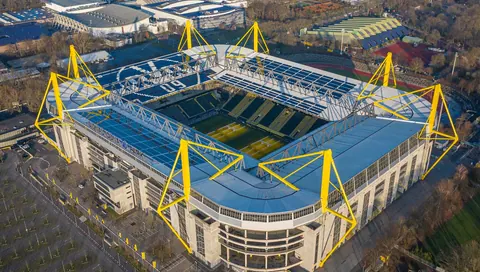
By the club’s count this is the biggest stadium in Germany, with room for 81,365 spectators.
It opened as the Westfalenstadion on 2 April 1974, with a friendly against Schalke 04. That summer Zaire, Scotland, Sweden, Brazil and the Netherlands played their World Cup group matches there. It went up as a prefabricated pallet-system structure, modelled on Montreal’s Olympic city. The club’s history page gives the finished ground as just under 54,000 places, only 17,000 of them seats.
It then grew in stages:
- 1992The north stand switched from standing to seats, which cut capacity to 42,800.
- Three years laterThe west and east stands each gained an upper tier of 6,000 seats.
- 1999Capacity rose to 68,600, and the Südtribüne, which the club calls the epicentre of Dortmund’s football passion, grew to 24,454 places, Europe’s biggest standing terrace.
- 13 September 2003The third stage was completed, adding about 14,000 more.
Eight yellow steel pylons outside the stadium took over from the corner pylons that carried the roof, and each stands 62 metres high.
Facts
| Official name | SIGNAL IDUNA PARK |
|---|---|
| Also called | Westfalenstadion, Dortmund stadium |
| Club | Borussia Dortmund |
| City | Dortmund, Germany |
| Opened | 1974 |
| Capacity | 81,365 |
| Stations | Stadion, Westfalenhallen, Theodor-Fliedner-Heim, Dortmund Signal-Iduna-Park, Dortmund Hauptbahnhof |
| Coordinates | 51.49250, 7.45167 |
In our lists
- The biggest football stadiums — 5th of 112 by capacity
- The oldest football grounds — 64th of 112 by age
- Stadium tours and museums
- Clubs where members buy first
Map
- Signal Iduna Park
- Stadion
- Westfalenhallen
- Theodor-Fliedner-Heim
- Dortmund Signal-Iduna-Park
- Dortmund Hauptbahnhof
Nearby stadiums
Veltins-Arena
Gelsenkirchen · 27 km away
BayArena
Leverkusen · 59 km away
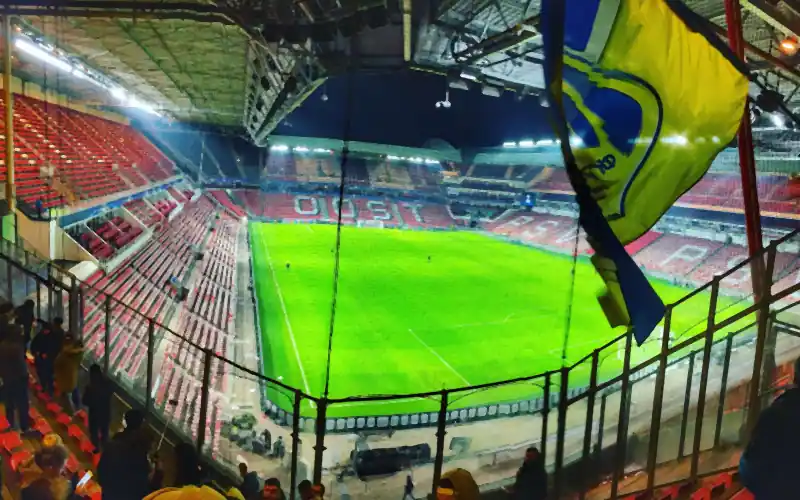
Philips Stadion
Eindhoven · 138 km away


Sources
Every fact on this page comes from one of 30 sources, each read and checked in November 2026.
- Borussia Dortmund: BVB-Heimspiele: Anreise und Parkenbvb.de · in German · retrieved 16 November 2026
- Borussia Dortmund: Einlass und Zutritt zum SIGNAL IDUNA PARKbvb.de · in German · retrieved 16 November 2026
- Borussia Dortmund: Geschichte des SIGNAL IDUNA PARKbvb.de · in German · retrieved 16 November 2026
- Borussia Dortmund: FAQ Heimspiel SIGNAL IDUNA PARKbvb.de · in German · retrieved 16 November 2026
- Borussia Dortmund: FAQ Tickets & Dauerkartenbvb.de · in German · retrieved 16 November 2026
- DSW21: Arrival Signal Iduna Parkbus-und-bahn.de · in English · retrieved 16 November 2026
Show all 30 sources
- Borussia Dortmund: Stadionspaziergang im SIGNAL IDUNA PARKbvb.de · in German · retrieved 16 November 2026
- Borussia Dortmund: Stadionplan des SIGNAL IDUNA PARKbvb.de · in German · retrieved 16 November 2026
- Borussia Dortmund: BVB-Ticket AGBbvb.de · in German · retrieved 16 November 2026
- Borussia Dortmund: NFC-Ticketsbvb.de · in German · retrieved 16 November 2026
- Borussia Dortmund: Stadiontouren im SIGNAL IDUNA PARKbvb.de · in German · retrieved 16 November 2026
- Borussia Dortmund: Die Südtribüne des SIGNAL IDUNA PARKbvb.de · in German · retrieved 16 November 2026
- Borussia Dortmund: BVB-Zweitmarkt für Käuferbvb.de · in German · retrieved 16 November 2026
- Wikidata: Westfalenstadion (Q150928)wikidata.org · in English · retrieved 16 November 2026
- Borussia Dortmund: Der SIGNAL IDUNA PARKbvb.de · in German · retrieved 16 November 2026
- Borussia Dortmund: Vorverkaufstermine für BVB-Ticketsbvb.de · in German · retrieved 16 November 2026
- Borussia Dortmund: REWE-Familienblock des BVBbvb.de · in German · retrieved 16 November 2026
- Borussia Dortmund: Stadionordnungbvb.de · in German · retrieved 16 November 2026
- Borussia Dortmund: Öffentliche BVB-Stadiontourenbvb.de · in German · retrieved 16 November 2026
- Borussia Dortmund: BORUSSEUMbvb.de · in German · retrieved 16 November 2026
- Borussia Dortmund: BVB-Tickets für Rollstuhlplätzebvb.de · in German · retrieved 16 November 2026
- Wikidata: Dortmund Signal-Iduna-Park station (Q800682)wikidata.org · in English · retrieved 16 November 2026
- Wikidata: Dortmund Central Station (Q704394)wikidata.org · in English · retrieved 16 November 2026
- Borussia Dortmund: BVB-Ticket-Zweitmarktbvb.de · in German · retrieved 16 November 2026
- Borussia Dortmund: BVB-Zweitmarkt für Verkäuferbvb.de · in German · retrieved 16 November 2026
- Borussia Dortmund: BVB-Stadiondeckelbvb.de · in German · retrieved 16 November 2026
- Borussia Dortmund: Mitgliedschaftbvb.de · in German · retrieved 16 November 2026
- OpenStreetMap: Node 3382802394: Stadionopenstreetmap.org · in English · retrieved 16 November 2026
- OpenStreetMap: Node 2069813793: Westfalenhallenopenstreetmap.org · in English · retrieved 16 November 2026
- OpenStreetMap: Node 677300600: Theodor-Fliedner-Heimopenstreetmap.org · in English · retrieved 16 November 2026