Stadium guide · Dublin, Ireland
Aviva Stadium
Republic of Ireland national team (FAI)
- Capacity
- 51,711
- Opened
- 2010
Tickets
Aviva Stadium does not sell tickets for what happens inside it: the organiser of each event distributes them. For a Republic of Ireland match that means the FAI, and the stadium points you to the FAI and Ticketmaster for up-to-date ticket information.
Tickets for events here come from the event organiser, not from Aviva Stadium itself.
Republic of Ireland national team (FAI)
Official- Who sells
- The match organiser, not the stadium. The stadium points to Ticketmaster and the FAI
- Your ticket
- A mobile-wallet ticket you tap at the turnstile; no barcode needed
- Screenshots
- Not accepted at the gate
- Phone problems
- Scan the rotating barcode from your account, or ask at the Ticketmaster kiosk with ID
- Passing it on
- Ticketmaster Ticket Transfer, if the organiser has switched it on
- Children
- A baby in arms under two needs no ticket; under-14s need an adult aged 18 or over
- Accessible
- Personal assistant’s ticket, arranged through the match host
Official routes only. We do not link to resale sites for clubs in England, Wales or Scotland.
The ticket on your phone
Tap, don’t scan: the ticket is NFC-enabled, so you hold your phone’s mobile wallet to the turnstile and no barcode is needed. A screenshot is useless at the gate, because entry needs the live ticket in the mobile website or the wallet. If you use the Ticketmaster app, open the ticket once before you leave, since a ticket you have viewed is saved and scans without an internet connection.
When the wallet or the tap fails, the stadium’s fallback is to log in to Account Manager, open your tickets and scan the rotating barcode at the turnstile. A lost, broken or flat phone can still be fixed on the day: the Ticketmaster kiosk at the stadium prints a ticket if you show ID.
Giving a ticket to someone else
Hand a ticket over through Ticketmaster’s Ticket Transfer, which works only for events where the organiser has switched it on. Once your friend accepts, they receive a fresh barcode that nobody else can use, and the copy left on your phone stops being valid for entry.
Children, seats and accessible tickets
Babies in arms under two need no ticket. Under-14s are let in only with an adult of 18 or over who supervises them. Everyone else needs a valid ticket for that event and must be able to produce it at any time inside. Stay in the seat your ticket gives you; moving to another needs the say-so of staff or stewards.
Wheelchair users, and fans with reduced mobility or with audio or visual impairments, may be entitled to a ticket for a personal assistant. Ask the match host about it rather than the stadium. If you plan to bring a guide dog, talk to the organiser before you book, not after.
Where to sit
Read the colour printed on your ticket before you set off, because it decides which side of the ground you walk to. The stadium is reached by five colour-coded routes, and the one you must take depends on where your seat is. Each colour leads to its own entrance and area, and serves set levels:
- BlueWest side, through the Shelbourne Road entrance; every level.
- OrangeWest side, through the Lansdowne Lane entrance; Level 1 only.
- GreenSouth side, through the Lansdowne Road entrance; every level.
- RedNorth and east sides, through the Bath Avenue entrance; Levels 1 and 5.
- PurpleEast side, through the Herbert Road entrance; every level.
The colour is one of five pieces of information on the ticket meant to guide you to your seat. The turnstile letter is another, and it is chosen to give you the most direct way to your block.
Step-free entry has five dedicated access points: Entrance E (Lower West Stand), Entrance X (Upper West Stand), Entrance A (South Stand), Entrance M (East Stand) and Entrance I (North Stand). There are 230 wheelchair places with as many again for personal assistants, spread over all levels and reached by lift. The 51 accessible toilets are placed beside every viewing position.
| Area | Who sits there |
|---|---|
| Blue Area | West side, entered from Shelbourne Road; all levels |
| Orange Area | West side, entered from Lansdowne Lane; Level 1 only |
| Green Area | South side, entered from Lansdowne Road; all levels |
| Red Area | North and east sides, entered from Bath Avenue; Levels 1 and 5 |
| Purple Area | East side, entered from Herbert Road; all levels |
Getting there
Let your ticket colour choose your station: the stadium’s directions send the five routes to two different DART stops. Any southbound DART from the city centre stops at both:
- DARTLansdowne Road2 min on footGreen and Purple routes
- DARTGrand Canal DockOrange, Blue and Red routes
- Lansdowne RoadFor Green, turn right out of the station onto Lansdowne Road; for Purple, continue down that road and keep left. Transport for Ireland puts the stadium roughly two minutes’ walk from the station.
- Grand Canal DockFor Orange and Blue, turn right onto Barrow Street and carry straight on into Shelbourne Road; for Red, go left at the end of Barrow Street onto Grand Canal Street, then left again into Bath Avenue.
Coming in by train to Connolly, you don’t need to leave the rail network: the DART runs from there straight to Lansdowne Road.
The stadium’s own advice is to walk from the city centre where you can, about 30 minutes, or otherwise use the DART or Dublin Bus. Buses from the centre also split by colour:
- Orange, Blue and GreenAny route serving Northumberland Road or Pembroke Road.
- PurpleRoutes serving Ringsend/Irishtown or Sandymount.
- RedRoutes serving Ringsend/Irishtown.
Driving and accessible parking
For traffic, transport and parking restrictions around an event, the stadium directs you to the Garda website. Accessible parking passes are limited in number and handed out to ticket holders by the event organiser, at least five working days before the event. If you hold one, arrive early: entry to that car park shuts two hours before the event starts, because of road closures put in place by An Garda Síochána.
Where to stay
Sleep in the city centre or close to one of the two DART stations the stadium’s directions rely on. Three areas, and what each gives you on the day:
- Area 1
Dublin city centre
The stadium puts the walk from the city centre at 30 minutes, and southbound DART trains run from there to Lansdowne Road and Grand Canal Dock. From Connolly station, the DART goes straight to Lansdowne Road.
- Area 2
Around Lansdowne Road station
Lansdowne Road DART station is about a two-minute walk from the stadium, and it is the stop for the Green and Purple entrances.
- Area 3
Grand Canal Dock
Grand Canal Dock DART station is the stop for the Orange, Blue and Red entrances, reached on foot via Barrow Street.
- Dublin city centreThe stadium reckons the walk at 30 minutes, southbound DART trains reach both stations, and from Connolly the DART is direct to Lansdowne Road.
- Around Lansdowne RoadIts DART station is about two minutes on foot from the stadium and is the stop for the Green and Purple entrances.
- Grand Canal DockThe DART stop for the Orange, Blue and Red entrances, which you reach on foot by way of Barrow Street.
Leave anything bulky where you’re staying, since each person may take only one small bag, no bigger than A4, into the stadium.
Matchday
Pack for an A4 limit: each person may bring one small bag and nothing larger. Folding a bigger bag over to shrink it doesn’t get it past the check. Bags are inspected at an outer cordon, where a bag gauge decides if the size is in question.
Doors open by level. For football and rugby, Levels 1 and 5 generally open 1.5 hours before kick-off and Level 3 two hours before, though the stadium says it depends on the event.
Leave these at home:
- flags, banners and poles
- bottles, cans and glasses
- fireworks and smoke canisters
- alcohol of any kind
- buggies, strollers and prams
Umbrellas may not be put to use inside the stadium. A small camera is allowed at football and rugby matches, but not with a lens bigger than 70mm. The whole ground is smoke-free, and that covers e-cigarettes and vapes.
Bring a card or a phone to pay, because every bar and food kiosk is cashless at every event. Bank cards and Apple, Android and Google Pay are all taken. Drinks are served in reusable cups with no deposit, and the stadium asks you to return them to a bar or drop them in a cup collection bin. At most major internationals there are kiosks and food stands open on every level. Each concourse has bar and food counters with a lowered section for wheelchair users, and restaurants, bars and kiosks are fitted with hearing induction loops.
The stadium
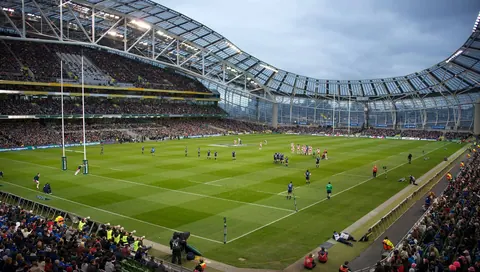
The Aviva Stadium took the place of Lansdowne Road, a ground founded in 1872. Building ran from 2007 to 2010, and the new stadium opened on 14 May 2010. Ireland’s rugby and football national teams both play their home games here and share it equally. Its capacity is 51,711.
International football at the old Lansdowne Road began on 23 April 1927, against an Italian side. The last Republic of Ireland match there, before it was replaced, was a 5-0 win over San Marino on 15 November 2006.

Facts
| Official name | Aviva Stadium |
|---|---|
| Also called | Lansdowne Road, Aviva Stadium Dublin |
| Club | Republic of Ireland national team (FAI) |
| City | Dublin, Ireland |
| Opened | 2010 |
| Capacity | 51,711 |
| Stations | Lansdowne Road (2 min on foot), Grand Canal Dock |
| Coordinates | 53.33496, -6.22825 |
In our lists
- The biggest football stadiums — 35th of 112 by capacity
- The oldest football grounds — 99th of 112 by age
Map
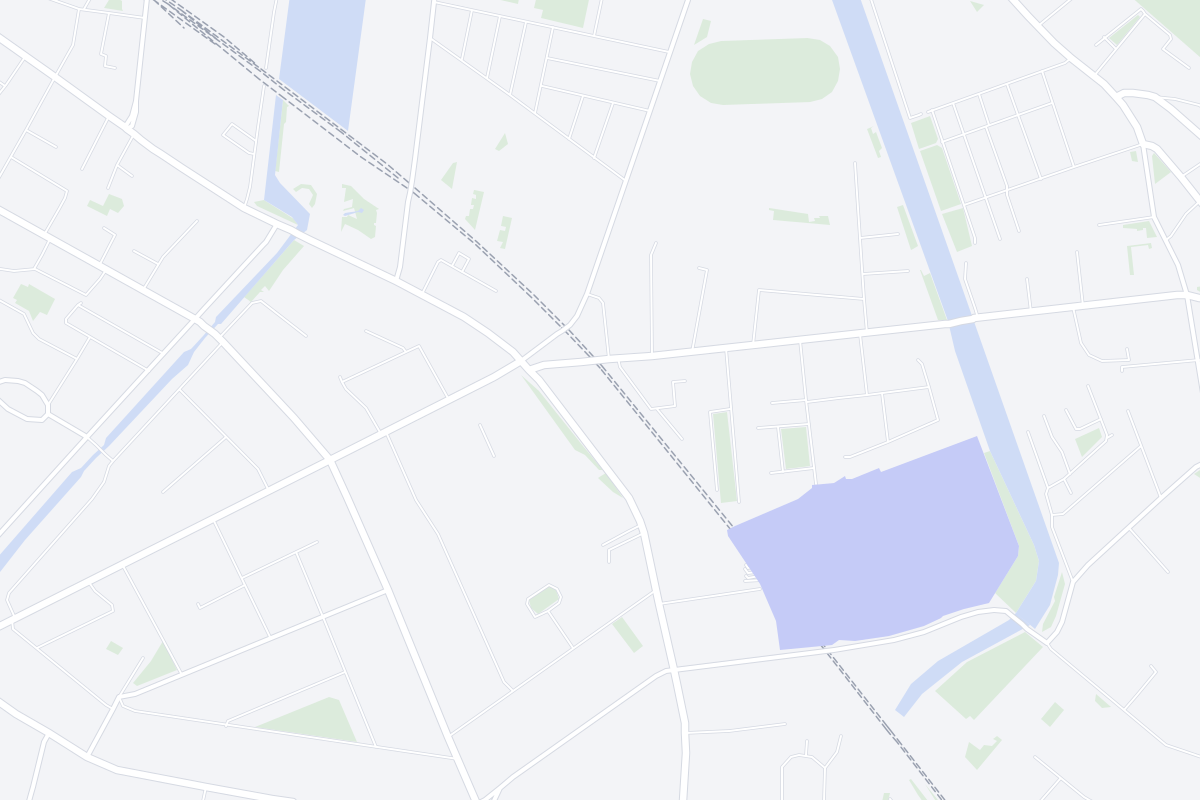
- Aviva Stadium
- Lansdowne Road
- Grand Canal Dock
Nearby stadiums
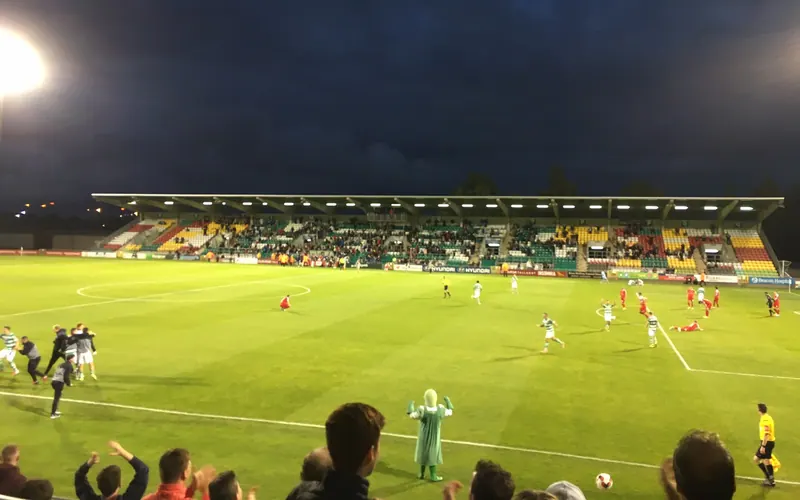
Tallaght Stadium
Dublin · 11 km away


Sources
Every fact on this page comes from one of 16 sources, each read and checked in November 2026.
- Aviva Stadium: FAQs and Ground Rulesavivastadium.ie · in English · retrieved 16 November 2026
- Aviva Stadium: Getting Here: Finding Your Entry Pointavivastadium.ie · in English · retrieved 16 November 2026
- Aviva Stadium: Getting Here: Finding Your Seatavivastadium.ie · in English · retrieved 16 November 2026
- Aviva Stadium: Aviva Stadium Bag Policyavivastadium.ie · in English · retrieved 16 November 2026
- Aviva Stadium: Historyavivastadium.ie · in English · retrieved 16 November 2026
- Aviva Stadium: Match information page (general notes only)avivastadium.ie · in English · retrieved 16 November 2026
Show all 16 sources
- Wikipedia: Aviva Stadiumen.wikipedia.org · in English · retrieved 16 November 2026
- Aviva Stadium: Getting Here: Accessibilityavivastadium.ie · in English · retrieved 16 November 2026
- Ticketmaster Ireland: How do I transfer tickets?help.ticketmaster.ie · in English · retrieved 16 November 2026
- Wikidata: Aviva Stadium (Q244402)wikidata.org · in English · retrieved 16 November 2026
- Aviva Stadium: Aviva Stadiumavivastadium.ie · in English · retrieved 16 November 2026
- Ticketmaster Ireland: How do I use the Ticketmaster App?help.ticketmaster.ie · in English · retrieved 16 November 2026
- Irish Rail: Additional Services for Up Coming Concerts and Eventsirishrail.ie · in English · retrieved 16 November 2026
- Transport for Ireland: Events at the Aviva Stadiumtransportforireland.ie · in English · retrieved 16 November 2026
- OpenStreetMap: Lansdowne Road station (node 7176421921)openstreetmap.org · in English · retrieved 16 November 2026
- OpenStreetMap: Grand Canal Dock station (node 7184996494)openstreetmap.org · in English · retrieved 16 November 2026